👩🏻⚕️ CURAI • 2025
Supercharging clinicians with AI-assisted care tools
Curai Health is a virtual clinic in the Bay Area that provides care to thousands of patients across the U.S. through their mobile app, EMR, and in-house care team. Simple visits were taking way too long as patient volumes grew.
Over 12 months, my team explored how to boost the efficiency of our doctors and nurse practitioners through improved UX, automations and AI-assisted workflows. On average, a clinician saw over 100 patients in a day, and the team performed 1500+ visits daily.


MY ROLE & IMPACT
As Product Design Lead, I set the experience vision and worked with PM, Engineering, and AI to plan out 3-4 quarters worth of features to get us there. I created a design system built in tandem with the care team to redesign the EMR from the ground up, and designed several new features that cut visit times in half.
One of our first features: faster Rx through automating refill data into the visit notes. Cut Rx visits from 15+ minutes down to ~7.
Through regular ideation sessions with the care team, we first launched a quick Rx refill solution in 2x 2-week sprints.
Larger ideas were scoped down in favor of launching ASAP to help our overworked team. The final design was small but mighty, factoring in tons of micro details tuned in to how the care team works, thinks and communicates.
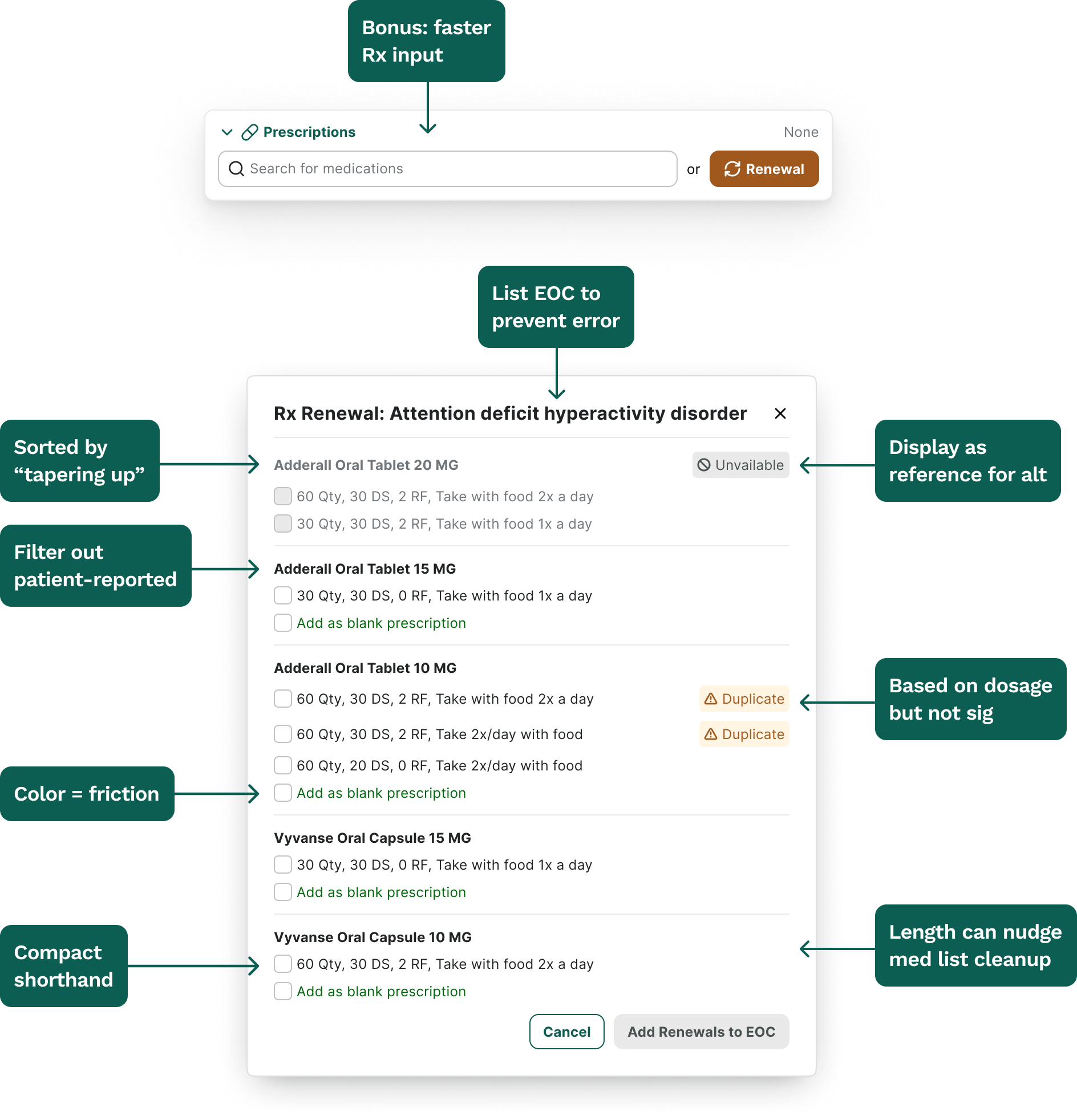
The refill feature was small but mighty, factoring in tons of micro details tuned in to how the care team works, thinks and communicates.
The vision started with a question: how can we enable the clinician to spend more time building a human connection with the patient?
Once we had more breathing room, we got to work exploring the next step towards the vision: a new copilot experience that brought prescription context to the clinician.
Clinicians spent minutes in each meeting hunting for context, searching for buttons, and crossing through the interface. Instead we brought the context to them so they could focus on the patient.
At the start of the visit, the copilot surfaced to-dos—like Rx refills the patient was ready for—safety checklists and preventative reminders, all at-a-glance.
The copilot surfaced up lab results needed by the clinician in order to verify the refill, instead of having to hunt it down through cumbersome tabs and panels.
My team worked with clinical operations and AI engineers to imagine what it looked like if patients could skip Rx refill visits altogether.
The result was a prototyped workflow that allowed patients to submit their request without having to interrupt their day with a doctor’s visit. The AI copilot did the heavy lifting while keeping the doctor in the loop for safety, letting them quickly see context, edit the script and get it filled.
The copilot surfaced up lab results needed by the clinician in order to verify the refill, instead of having to hunt it down through cumbersome tabs and panels.
On top of cutting visit time in half, the long-lasting effects of these projects was new collaboration rituals built between design, engineering, AI and clinical.
Through ongoing shadowing, backlogging, brainstorms, and beta testing with the care team, we opened lines of communication that let us find and launch improvements to the clinical experience dramatically faster.
Better tooling meant happier care team, and that meant happier patients.
Want to learn more?
This are just some of the details about this project. Please reach out if you’d like to know more, and I’d be happy to chat or present a case study.

jfchiappone@gmail.com


👩🏻⚕️ CURAI • 2025
Supercharging clinicians with AI-assisted care tools
Curai Health is a virtual clinic in the Bay Area that provides care to thousands of patients across the U.S. through their mobile app, EMR, and in-house care team. Simple visits were taking way too long as patient volumes grew.
Over 12 months, my team explored how to boost the efficiency of our doctors and nurse practitioners through improved UX, automations and AI-assisted workflows. On average, a clinician saw over 100 patients in a day, and the team performed 1500+ visits daily.
MY ROLE & IMPACT
As Product Design Lead, I set the experience vision and worked with PM, Engineering, and AI to plan out 3-4 quarters worth of features to get us there. I created a design system built in tandem with the care team to redesign the EMR from the ground up, and designed several new features that cut visit times in half.
One of our first features: faster Rx through automating refill data into the visit notes. Cut Rx visits from 15+ minutes down to ~7.
Through regular ideation sessions with the care team, we first launched a quick Rx refill solution in 2x 2-week sprints.
Larger ideas were scoped down in favor of launching ASAP to help our overworked team. The final design was small but mighty, factoring in tons of micro details tuned in to how the care team works, thinks and communicates.
The refill feature was small but mighty, factoring in tons of micro details tuned in to how the care team works, thinks and communicates.
The vision started with a question: how can we enable the clinician to spend more time building a human connection with the patient?
Once we had more breathing room, we got to work exploring the next step towards the vision: a new copilot experience that brought prescription context to the clinician.
Clinicians spent minutes in each meeting hunting for context, searching for buttons, and crossing through the interface. Instead we brought the context to them so they could focus on the patient.
At the start of the visit, the copilot surfaced to-dos—like Rx refills the patient was ready for—safety checklists and preventative reminders, all at-a-glance.
The copilot surfaced up lab results needed by the clinician in order to verify the refill, instead of having to hunt it down through cumbersome tabs and panels.
My team worked with clinical operations and AI engineers to imagine what it looked like if patients could skip Rx refill visits altogether.
The result was a prototyped workflow that allowed patients to submit their request without having to interrupt their day with a doctor’s visit. The AI copilot did the heavy lifting while keeping the doctor in the loop for safety, letting them quickly see context, edit the script and get it filled.
The copilot surfaced up lab results needed by the clinician in order to verify the refill, instead of having to hunt it down through cumbersome tabs and panels.
On top of cutting visit time in half, the long-lasting effects of these projects was new collaboration rituals built between design, engineering, AI and clinical.
Through ongoing shadowing, backlogging, brainstorms, and beta testing with the care team, we opened lines of communication that let us find and launch improvements to the clinical experience dramatically faster.
Better tooling meant happier care team, and that meant happier patients.
Want to learn more?
This are just some of the details about this project. Please reach out if you’d like to know more, and I’d be happy to chat or present a case study.
jfchiappone@gmail.com
👩🏻⚕️ CURAI • 2025
Supercharging clinicians with AI-assisted care tools
Curai Health is a virtual clinic in the Bay Area that provides care to thousands of patients across the U.S. through their mobile app, EMR, and in-house care team. Simple visits were taking way too long as patient volumes grew.
Over 12 months, my team explored how to boost the efficiency of our doctors and nurse practitioners through improved UX, automations and AI-assisted workflows. On average, a clinician saw over 100 patients in a day, and the team performed 1500+ visits daily.


MY ROLE & IMPACT
As Product Design Lead, I set the experience vision and worked with PM, Engineering, and AI to plan out 3-4 quarters worth of features to get us there. I created a design system built in tandem with the care team to redesign the EMR from the ground up, and designed several new features that cut visit times in half.
One of our first features: faster Rx through automating refill data into the visit notes. Cut Rx visits from 15+ minutes down to ~7.
Through regular ideation sessions with the care team, we first launched a quick Rx refill solution in 2x 2-week sprints.
Larger ideas were scoped down in favor of launching ASAP to help our overworked team. The final design was small but mighty, factoring in tons of micro details tuned in to how the care team works, thinks and communicates.
The refill feature was small but mighty, factoring in tons of micro details tuned in to how the care team works, thinks and communicates.
The vision started with a question: how can we enable the clinician to spend more time building a human connection with the patient?
Once we had more breathing room, we got to work exploring the next step towards the vision: a new copilot experience that brought prescription context to the clinician.
Clinicians spent minutes in each meeting hunting for context, searching for buttons, and crossing through the interface. Instead we brought the context to them so they could focus on the patient.
At the start of the visit, the copilot surfaced to-dos—like Rx refills the patient was ready for—safety checklists and preventative reminders, all at-a-glance.
The copilot surfaced up lab results needed by the clinician in order to verify the refill, instead of having to hunt it down through cumbersome tabs and panels.
My team worked with clinical operations and AI engineers to imagine what it looked like if patients could skip Rx refill visits altogether.
The result was a prototyped workflow that allowed patients to submit their request without having to interrupt their day with a doctor’s visit. The AI copilot did the heavy lifting while keeping the doctor in the loop for safety, letting them quickly see context, edit the script and get it filled.
The copilot surfaced up lab results needed by the clinician in order to verify the refill, instead of having to hunt it down through cumbersome tabs and panels.
On top of cutting visit time in half, the long-lasting effects of these projects was new collaboration rituals built between design, engineering, AI and clinical.
Through ongoing shadowing, backlogging, brainstorms, and beta testing with the care team, we opened lines of communication that let us find and launch improvements to the clinical experience dramatically faster.
Better tooling meant happier care team, and that meant happier patients.
Want to learn more?
This are just some of the details about this project. Please reach out if you’d like to know more, and I’d be happy to chat or present a case study.
jfchiappone@gmail.com

